
Early childhood is a beautiful stage of discovery, exploration, and learning. Children learn best when they are given opportunities to touch, observe, explore, experiment, and learn through meaningful experiences. At i-SKY Global Preschool and Daycare, Montessori activities are thoughtfully designed to encourage children to learn through hands-on experiences while developing essential skills for everyday life.
Our approach to Montessori education focuses on the overall development of the child, including cognitive growth, fine motor development, concentration, independence, communication, coordination, and social-emotional skills.
Learning Through Montessori Activities
Montessori activities allow children to become active participants in their own learning. Instead of simply listening to instructions, children get opportunities to handle materials, complete activities, solve simple problems, and discover concepts independently.
Activities such as sorting, matching, transferring, stacking, sequencing, threading, counting, tracing, practical life exercises, and sensory exploration help children understand concepts through direct experience.
This hands-on learning approach makes education enjoyable and meaningful for young learners.
Building Independence Through Practical Life Activities
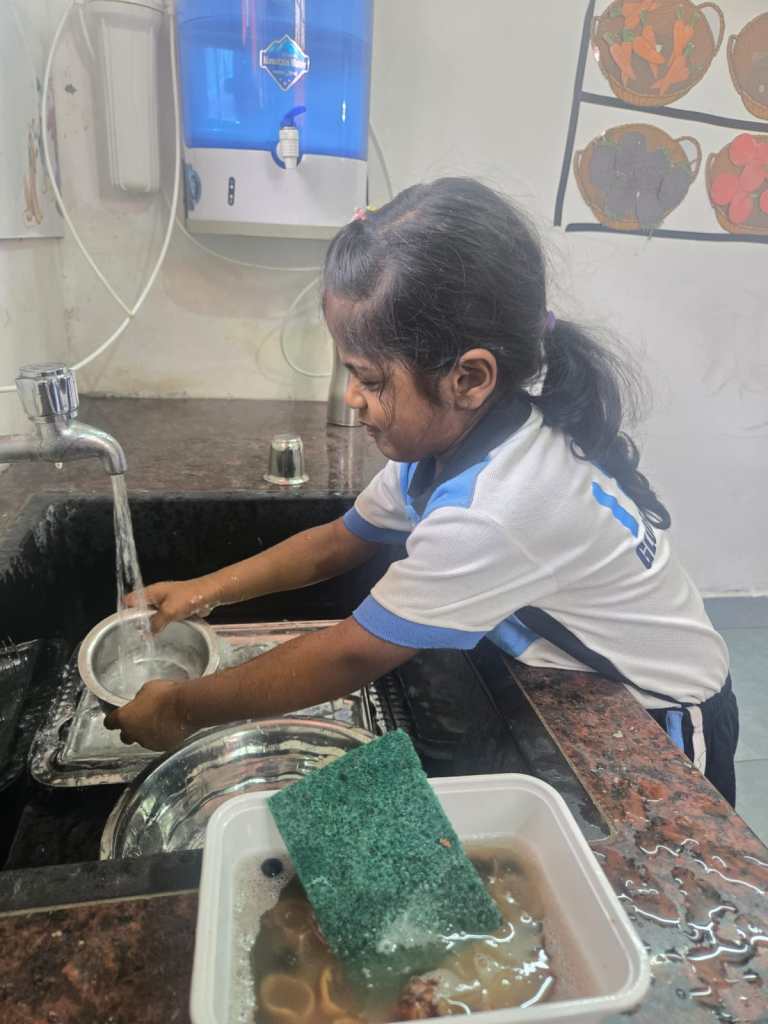
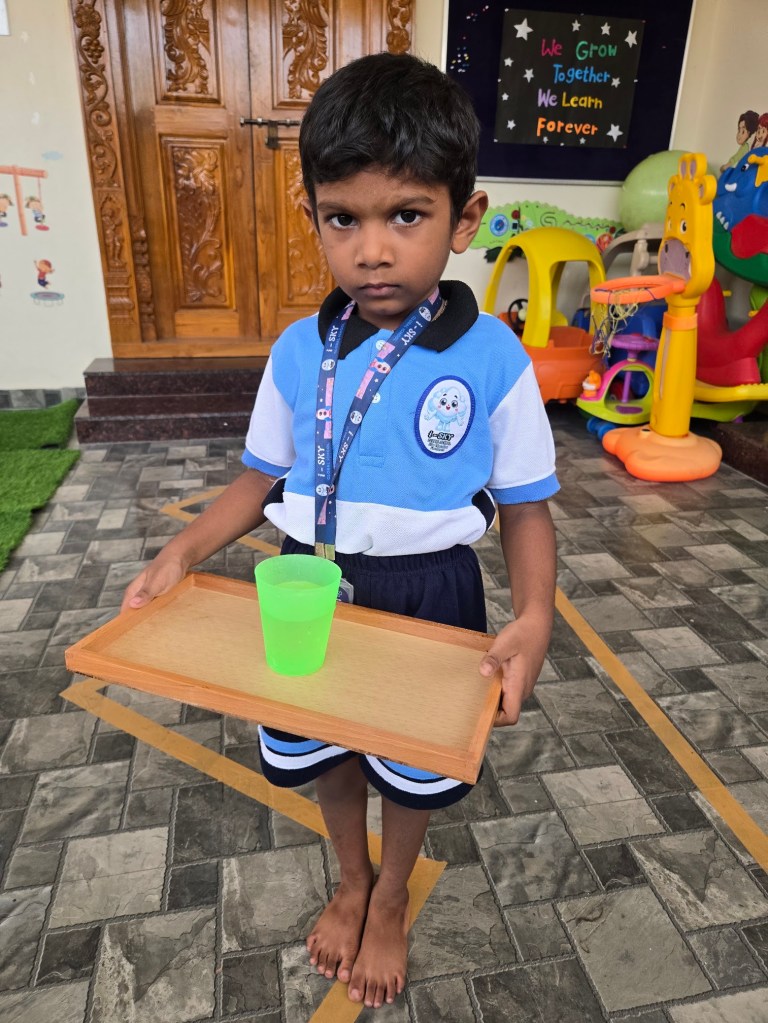
One of the important aspects of Montessori learning is Practical Life activities. These activities help children develop confidence and independence by introducing them to simple everyday tasks.
Children may participate in activities such as pouring, transferring objects, arranging materials, folding, cleaning, buttoning, opening and closing containers, and organizing their learning space.
These simple activities help children understand responsibility while improving hand control, coordination, concentration, and self-confidence.
When children successfully complete an activity on their own, they experience a sense of achievement that encourages them to try new challenges.
Developing Fine Motor Skills
Montessori activities provide excellent opportunities for strengthening children’s small muscles in their hands and fingers.
Activities involving beads, threading, transferring objects, puzzles, peg boards, tracing, sorting, and manipulating Montessori materials help improve fine motor skills and hand-eye coordination.
These skills are important for future classroom activities such as:
- Writing and pencil control
- Drawing and colouring
- Cutting and pasting
- Buttoning and dressing
- Handling classroom materials
- Performing everyday tasks independently
Regular hands-on activities help children gradually develop better control and coordination.
Improving Concentration and Focus
Young children naturally have a strong sense of curiosity. Montessori activities channel this curiosity into purposeful learning.
When children are encouraged to complete an activity step by step, they learn to focus their attention on a particular task. Repeating an activity also helps them improve their concentration and understand the process more clearly.
Montessori learning therefore supports the development of attention span, focus, patience, and perseverance.
Encouraging Cognitive Development
Montessori activities are not only about physical interaction. They also encourage children to think, observe, compare, classify, remember, and solve problems.
For example, sorting activities help children understand similarities and differences. Matching activities develop observation and memory. Sequencing activities introduce logical order, while counting materials help children understand early mathematical concepts.
Through these experiences, children develop important early learning and problem-solving skills.
Supporting Sensory Learning
Sensory exploration plays an important role in early childhood education. Montessori materials often provide opportunities for children to explore different textures, shapes, sizes, sounds, colours, and weights.
Sensory activities help children observe details and understand the world around them through their senses.
This type of learning can support:
- Sensory awareness
- Observation skills
- Vocabulary development
- Concentration
- Classification skills
- Cognitive development
Sensory-based learning makes classroom experiences more engaging and interactive for young children.
Developing Early Mathematical Skills
Montessori mathematics activities introduce children to numbers and quantities in a concrete and engaging way.
Using hands-on materials, children can explore counting, number recognition, quantity, sequencing, comparison, patterns, and basic mathematical concepts.
Instead of memorising numbers alone, children get opportunities to understand what numbers represent.
This foundation can make future mathematical learning easier and more meaningful.
Supporting Language and Communication
Montessori activities also provide opportunities for children to develop their vocabulary and communication skills.
Teachers introduce new words while children participate in activities involving objects, colours, shapes, actions, animals, nature, and everyday experiences.
Children are encouraged to observe, identify, name, describe, and communicate what they are doing.
Such experiences naturally support early language development, vocabulary building, listening skills, and communication confidence.
Encouraging Social and Emotional Development
Although Montessori learning encourages individual exploration, children also learn important social skills when they participate in a classroom environment.
Children learn to wait for their turn, respect others, share learning spaces, handle materials carefully, follow simple classroom routines, and communicate with teachers and peers.
These experiences support social-emotional development, self-confidence, patience, responsibility, and respect for others.
Learning at Their Own Pace
Every child is unique. Children have different interests, learning styles, abilities, and developmental stages.
A Montessori-inspired learning environment gives children opportunities to explore activities according to their readiness. Teachers observe children’s interests and guide them towards suitable learning experiences.
This encourages children to become confident learners without unnecessary pressure.
Why Montessori Learning Matters in a Preschool
A quality preschool should provide more than basic academic preparation. The early years are an important period for developing curiosity, independence, communication, coordination, and a positive attitude towards learning.
At i-SKY Global Preschool, Montessori activities are integrated into a child-friendly learning environment where children can learn through exploration and hands-on experiences.
Our preschool in Tondiarpet, Chennai focuses on creating engaging learning experiences that support the child’s physical, cognitive, language, social, emotional, and practical development.
Rather than making learning stressful, our goal is to make every learning experience enjoyable, purposeful, and age-appropriate.
Montessori Learning in Daycare
A nurturing daycare environment should also provide meaningful opportunities for learning and development throughout the day.
At i-SKY Global Daycare, children can engage in age-appropriate activities that combine care, exploration, play, creativity, and skill development.
Montessori-inspired activities can be especially valuable during daycare hours because they provide children with purposeful experiences while allowing them to explore, practise, and build confidence in a comfortable environment.
Our preschool and daycare in Tondiarpet aim to create a safe, welcoming, and stimulating environment where children can learn, play, interact, and grow.
A Holistic Approach to Early Childhood Education
At i-SKY Global, we believe that early childhood education should nurture the whole child.
Our learning experiences combine elements of Montessori education, play-based learning, sensory learning, practical life activities, project-based learning, and child-centred teaching approaches.
Every activity is planned with a developmental purpose. Whether children are sorting objects, transferring materials, completing a puzzle, tracing patterns, counting objects, or participating in a practical life activity, they are developing multiple skills simultaneously.
What Children Learn Through Montessori Activities
Through regular Montessori activities, children can develop:
- Fine motor skills
- Gross motor coordination
- Hand-eye coordination
- Concentration and focus
- Problem-solving abilities
- Early mathematical understanding
- Language and vocabulary
- Sensory awareness
- Independence
- Self-confidence
- Patience and perseverance
- Social skills
- Practical life skills
- Observation and classification skills
- Creativity and curiosity
These foundational skills prepare children for future academic learning as well as everyday life.
i-SKY Global – A Place to Explore, Learn and Grow
At i-SKY Global Preschool and Daycare, we believe children learn best when learning becomes an experience.
Our Montessori-inspired activities provide children with opportunities to explore, experiment, repeat, discover, and learn independently. With a nurturing environment, engaging activities, and child-centred guidance, we aim to build a strong foundation for lifelong learning.
If you are looking for a Montessori preschool in Tondiarpet, a quality preschool in Chennai, or a nurturing daycare in Tondiarpet, i-SKY Global Preschool and Daycare offers a learning environment where every child is encouraged to explore their potential.
Let Every Little Hand Discover Something New
From practical life activities to sensory exploration, early mathematics, language development, and fine motor activities, every Montessori experience contributes to a child’s overall development.
At i-SKY Global, we make the early years meaningful by giving children the freedom to explore, the confidence to try, and the guidance to learn.
i-SKY Global Preschool and Daycare – Nurturing Curious Minds, Building Confident Learners.
 i-SKY Global PreSchool and DayCare
Leave a comment